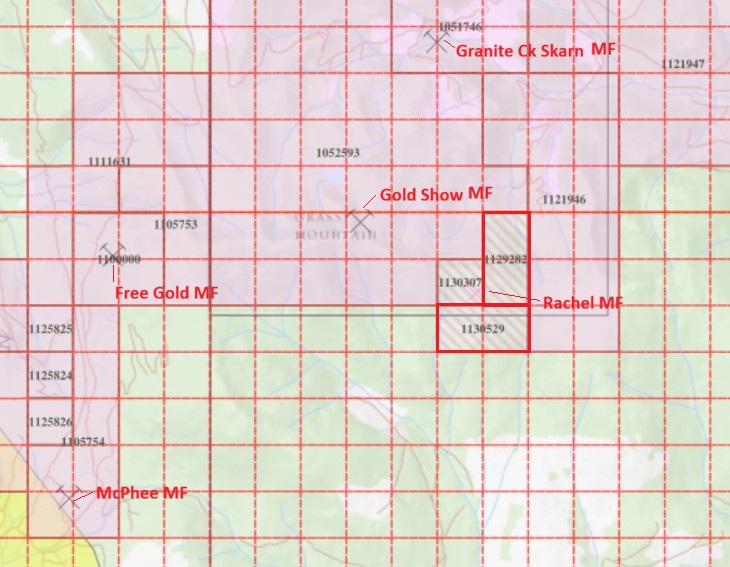
The Rachel PCX Tenures are 1129282 (2 cells) In Application 2026/Jan/17, 1130529 (2 cells) In Application 2026/Feb/25. The prolific Moyie Lake area has been extensively explored since the 1800’s. The Rachel vein was discovered in 1954.
From the Rachel Minfile this area is underlain by a granodiorite pluton, the Bonnington pluton, of the Lower to Middle Jurassic Nelson named Intrusions. The granodiorite is locally cut by aplite and lamprophyre dykes and quartz veins which are 0.5 to 3.0 centimetres wide and generally trend north and dip steeply. The granodiorite also exhibits two sets of jointing.
The Rachel vein is a north-northeast striking “saddle like” vein exposed in an adit on the south side of Grassy Mountain. The vein ranges from 10 to 40 centimetres wide and has a strike length of 25 metres and follows the 2 sets of joints to their junction. The vein is comprised of quartz with lenses, disseminations of galena, flakes of free gold, and traces of pyrite. A zone of argillic alteration does occur on the south side of the vein, and also some chloritization and sericitization occurs in the wallrock.
And in 1980, Kimberley Gold Mines did remove 14 tonnes of high grade ore from the adit, that did yield an average assay of 66.64 grams per tonne gold, 271.5 grams per tonne silver, and 9.42 per cent lead (Assessment Report 19021). A grab sample taken in 1989 from the middle of the adit did assay 174.5 grams per tonne gold, 331.5 grams per tonne silver and 10.05 per cent lead (Assessment Report 19021).
Also an extension of the west limb of the vein is exposed 15 metres to the west of the adit. And a grab sample taken in 1984 assayed 4.94 grams per tonne gold, 65.13 grams per tonne silver, and 2.42 per cent lead (Assessment Report 19021).
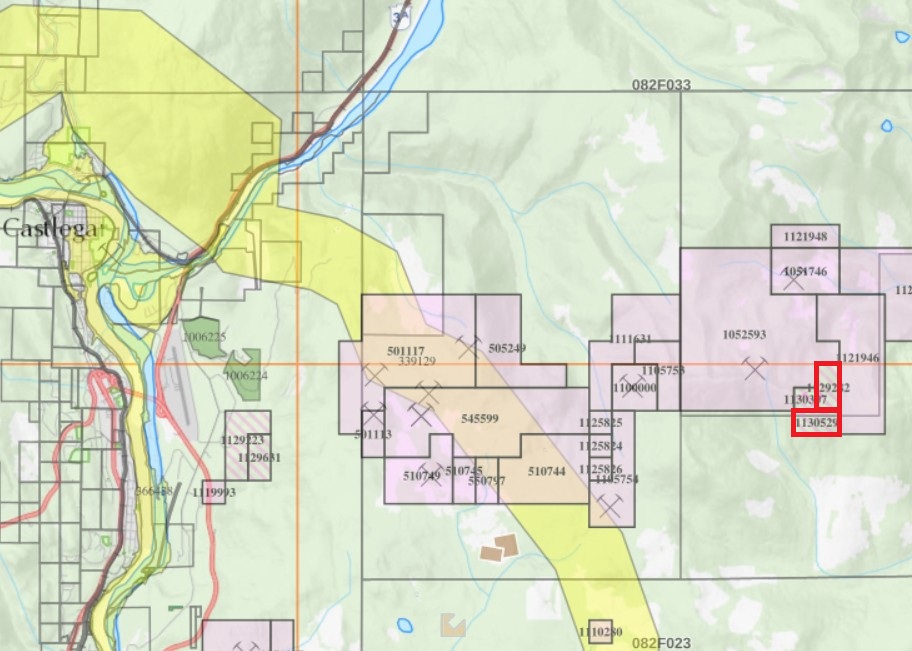
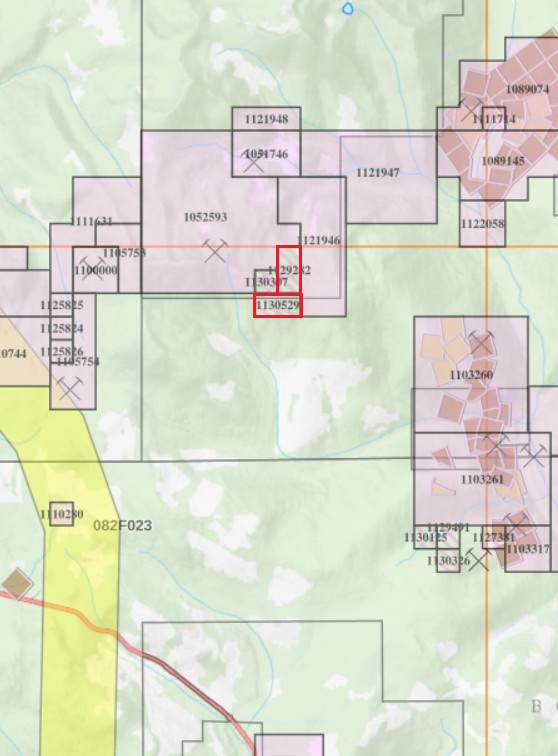
The map to the right shows the Minfile reports in the area where some highlights includes;
1. The Granite Creek Skarn Minfile; Rock samples from the adit waste dump assayed up to 9.2gpt Au, 50gpt Ag, and 4.51% Cu (Bronson, G.R. (2019-04-30): NI-43-101 Technical Report on the Pass Property with Recommendations on Further Exploration.
2. The Gold Show Minfile; Mineralization occurs locally with quartz veins that carry pyrite, and trace galena with sericite plus chlorite alteration. In 2005 a 0.25m quartz vein assayed 2.43gpt gold (ARIS 29759).
3. The Free Gold Minfile: In 2010 a rock sample of a narrow quartz vein had visible gold, known to be the Free Gold vein, that returned up to 18.13gpt gold (ARIS 31929).
4. The McPhee Minfile; The zone of massive pyrrhotite and chalcopyrite does occur within the pebble conglomerate. Historical adits and shafts have been driven on this mineralization. The massive sulphide band is 1 to 5 metres wide and has been traced on the surface for 1.5 kilometres. Rock samples for the massive sulphide zone did assay up to 0.7 per cent copper, 0.06 per cent cobalt, 0.26 per cent tungsten and 0.14 per cent molybdenum. Samples of the quartz pebble conglomerate also returned values up to 3.62 per cent zinc, 0.56 per cent lead, 42.5 grams per tonne silver and 0.15 grams per tonne gold. Rock samples of the andesite lithology did return values up to 13 grams per tonne gold, 6.8 grams per tonne silver, 1.5 per cent copper, 0.15 per cent nickel, 0.05 per cent cobalt and 3.8 per cent zinc. (George Cross Newsletter #60 (March 26, 1998).
The associated Cordierite showing, is an area of rust weathered, strongly magnetic, dark grey, pyritic, also altered and metamorphosed volcaniclastics, And locally is a cordierite-biotite-anthophyllite schist. Anomalous gold values, in the hundreds of parts per billion gold range, were returned from rock samples collected over a 10 metre wide zone, with a maximum value of 1.0gpt gold that is over a 1.0 metre width (Assessment Report 31929).
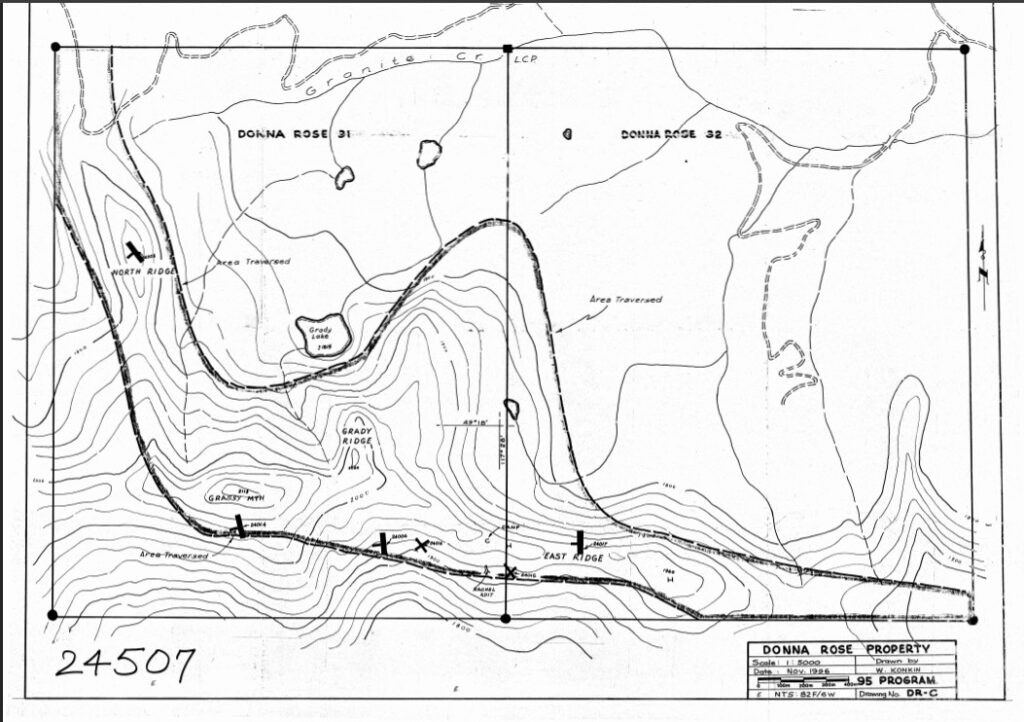
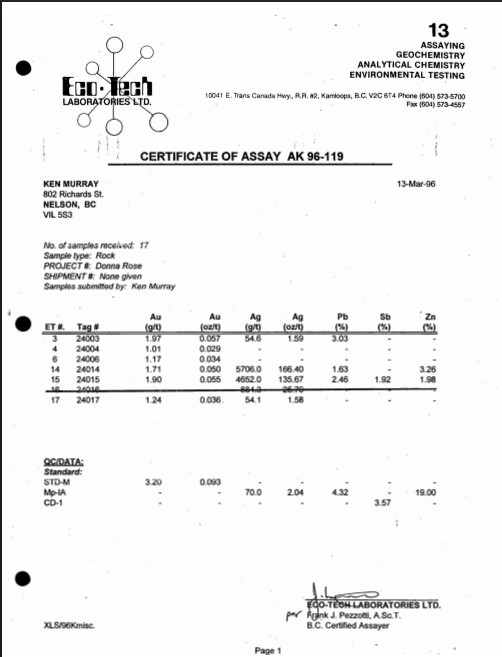
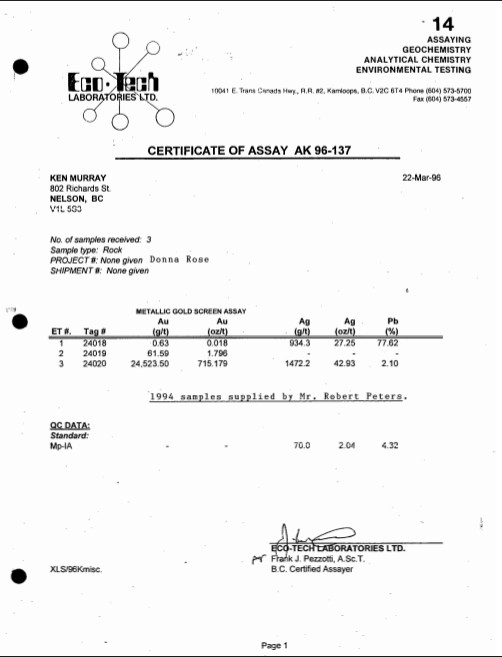
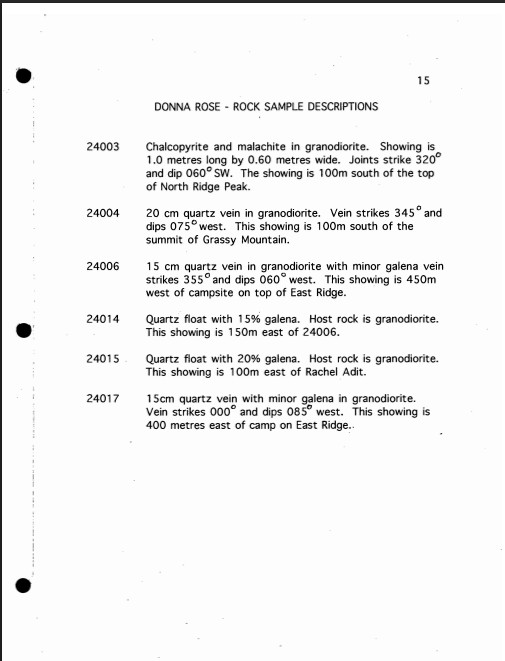
The 4 following slides are taken from the ARIS 24507 (1996) where the first map shows where 6 rock samples were taken and assayed (See the second slide for Assays from 1996). The third slide shows 3 rock sample assays, taken from the adit shown on slide 1 (1994). And the fourth slide is a description of the six rock sample taken in 1996 and assayed (See slide 2 for the 6 assays).
Also note on slide 3 the assay for the third sample taken from the Rachel Adit in 1994 had 715.18opt? Au, and 42.93opt Ag.
ASKING: Buyout or Option