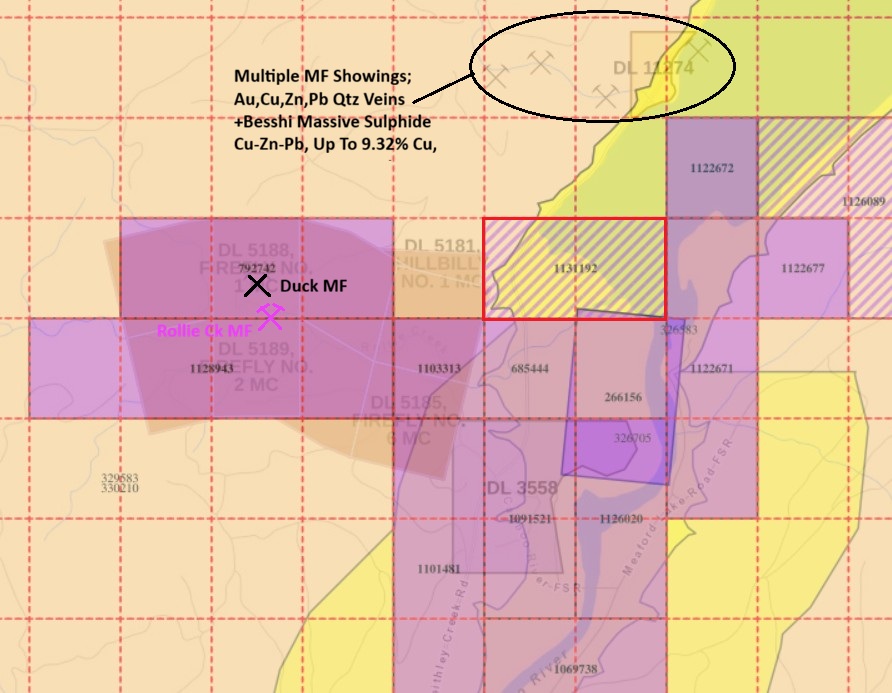
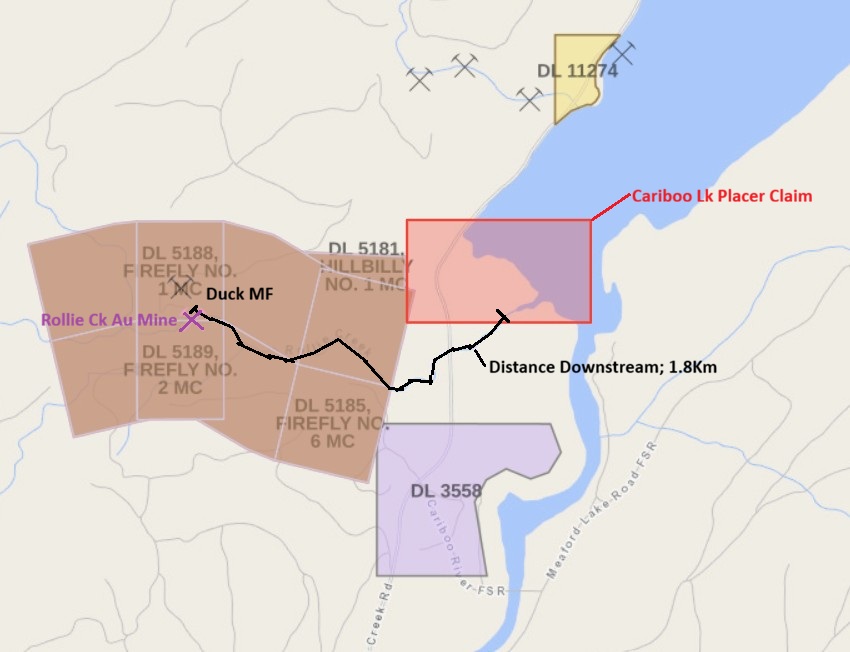
The Cariboo placer claims Tenure 1131192 (2 cells) In Application submission on March 17, 2026. The prolific Cariboo Area has produced gold for over a hundred years including from fine grained to nugget and larger sized gold. The closest Minfile is the Rollie Creek MF located 1.8Km southwest upstream of the Cariboo Lake PCX claim (See Map 2). And the Cariboo Lake Placer Claim is located 14.5 kilometers Northeast of Likely, British Columbia.
To summarize the Rollie Creek Minfile, here are the important points to consider. Placer gold was historically mined at Rollie (Duck) Creek from 1896-1900 amounting to 6344 grams gold (Or $1.4MM Cdn at today’s prices). The source of this gold is most likely from gold veins deposits of the quartzites of the Upper Proterozoic -Paleozoic Snowshoe Group.
“Past Data from the Cariboo mining district does indicate that the supergene leaching of gold dispersed within massive sulphides through Tertiary deep weathering and followed by Cenozoic erosion is probably the most likely explanation for the occurrence of coarse gold nuggets in Quaternary sediments” (Exploration in British Columbia 1989, page 147).
The first placer mining recorded in the Quesnel mining district was along the Quesnel River, and on Horsefly River in around 1859. In 1860, new discoveries were being made rapidly including; Keithley, Snowshoe, and Harvey creeks were discovered and a large amount of gold was produced before the earliest production was actually recorded in 1874. Probably fully one-third of the total production of the Quesnel district was believed to have been mined between the period of 1860 to 1873 (Bulletin 28).
The Duck Minfile located just above the Rollie Creek Minfile (Just mentioned see Map below) and the Duck property is underlain mainly by metasedimentary rocks of the Upper Proterozoic-Paleozoic Snowshoe Group and also granitic gneiss of the Devonian-Mississippian Quesnel Lake Gneiss unit. Pyrite/chalcopyrite occurs as strong disseminations and massive lenses within dark grey phyllites of the Snowshoe Group. And Pyrite, chalcopyrite, galena and sphalerite occur in quartz veins that cut the phyllite.
In 1988, drillholes D-1, D-2 and D-3 were placed to intersect the downdip extension of chalcopyrite-sphalerite-pyrrhotite mineralization exposed in black siltites about 60 to 100 metres to the south, in the Rollie Creek canyon. The holes did intersect abundant and widespread pyrite and pyrrhotite but only encountered weak and sporadic concentrations of chalcopyrite and sphalerite. The sulphides are widely disseminated throughout grey, greenish grey, green, dark grey and black phyllites. Some of the green phyllites display a distinct volcanic appearance mixed with recognizable relict feldspar or hornblende grains, moderately coarse fragmental textures and a basic lack of bedded structure. In drillholes D-1 and D-3, concentrations of 1768 ppm (0.17 per cent) and 2982 ppm (0.29 per cent) zinc occur respectively over six-metre intercept at the contact between black phyllite and green tuffite. Elsewhere, sphalerite and chalcopyrite appear to have a random distribution throughout the assemblage but only in sufficient concentrations to impart slightly anomalous values to the assayed sections. The highest concentrations of iron sulphide appear to be present in the black units. Except where contained in quartz-carbonate veins, the sulphides appear to be very fine grained and not easily seen without magnification, despite being present in concentrations up to four percent. It is noted that the black units encountered in these holes does consist of various combinations of soft black graphitic schist, dark grey phyllite and hard black siliceous siltite, or quartzite.
In 1987 and 1988 the Duck claims were staked to cover sulphide mineralization observed in dark grey phyllites of the Snowshoe Group. In 1987-88, Gibraltar Mines Limited did conduct a geochemical soil survey (1306 soil samples), VLF-EM survey (5.4 kilometres) and completed 7 NQ-size drillholes that totalled 1033.9 metres.
ASKING: $7,000.00Cdn Buyout or $25,000.00Cdn in 4 Years + 2% NSR Option.