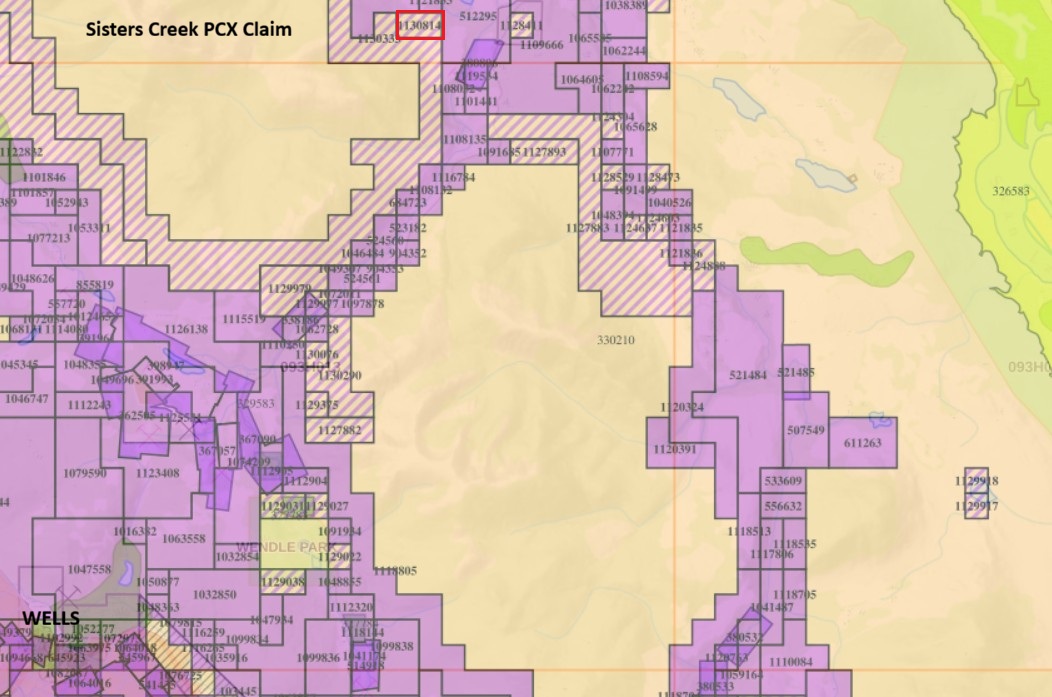
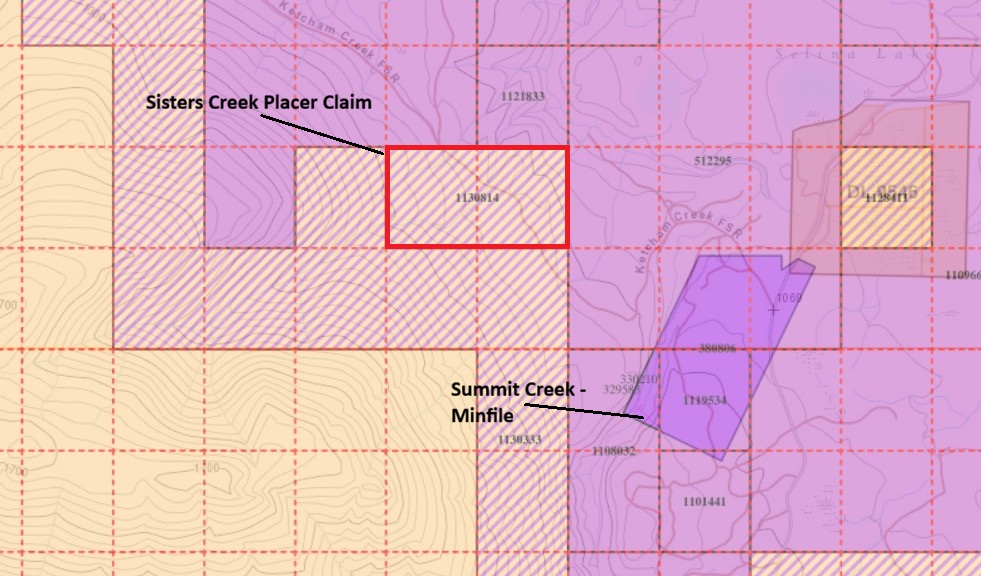
The Sisters Creek placer claims Tenure 1130814 (2 cells) In Application submission on March 03, 2026. The prolific Cariboo Area has produced gold for over a hundred years including from fine grained to nugget and larger sized gold. The closest Minfile is the Summit Creek MF located 0.9Km SE upstream of the Sisters Creek PCX claim (See Map 2). And the Sisters Placer Claim is located 14 kilometers Northeast of Wells, British Columbia.
To summarize the Summit Creek Minfile here are the important points to consider. Placer gold deposits of the Quesnel Highland region, including the former rich producers of the Barkerville Camp, have really accounted for a large proportion of British Columbia’s alluvial gold production. With the exception of only a few producers in the Wingdam area, that are underlain by Upper Triassic Nicola Group sediments, most all the deposits are underlain by the Upper Proterozoic to Lower Paleozoic Snowshoe Group. These rocks have all been metamorphosed to greenschist facies and are dominantly metasedimentary.
The Placer gold deposits in the region are generally found in mostly young Pleistocene gravels. Both the morphology and mineral associations of the gold doe suggests that it was most probably derived locally. Where the most obvious sources would be the numerous auriferous veins of the Downey succession of the Snowshoe Group.
Bench gravel placer mining has taken place in the narrow upper part of Summit Creek and also in a few places in the wider, lower part. Operations have also recorded on the Sisters Creek and the Hobo Gulch tributaries. Mining has been carried out by ground sluicing, hydraulicking and deep drifting. The Gold does occurs mainly in surface gravels overlying glacial drift. And the area is mainly underlain by basaltic rocks of the Mississippian-Permian Antler Formation (Slide Mountain Group). But the uppermost part of Summit creek is underlain by Snowshoe Group rocks.
It had been documented that between 1891 to 1945, intermittent production from Summit Creek totalled 19,189 grams gold (~$3.7MM at todays prices). From 1894 to 1896, production from Big Valley, Pinus (Pine) and Summit creeks was actually recorded under Shepherd Creek (093H 045)(Bulletin 28).
“Past Data from the Cariboo mining district does indicate that the supergene leaching of gold dispersed within massive sulphides through Tertiary deep weathering and followed by Cenozoic erosion is probably the most likely explanation for the occurrence of coarse gold nuggets in Quaternary sediments” (Exploration in British Columbia 1989, page 147).
ASKING: Buyout or Option